
STILL MOTION - Poems and Photographs
Poems by Jianzing heng & Photographs by Leo Touchet
Photo Circle Press ISBN: 979-8-9918323-1-1 - 62 pages - Paperback - 2025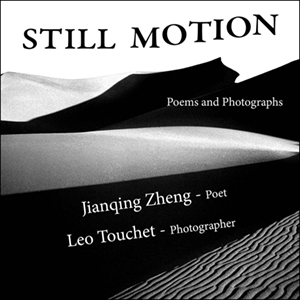
Reviewed by Michael A. Antonucci
Arkansas Review 56.2 August 2025
John Berger opens Ways of Seeing by asserting that “Seeing comes before words.” Explaining his claim, he writes, “The child looks and recognizes before it can speak.” Continuing his influential collection of exploratory essays on sight, reception, and visual art, Berger identifies “another sense in which seeing comes before words,” stating that “it is seeing which establishes our place in the surrounding world; we explain that world with words, but words can never undo the fact that we are surrounded by it. The relation between what we see and what we know is never settled.”
Written with clarity, strength, and direction, throughout its fifty-plus years in print, Ways of Seeing has remained relevent for changing audiences, over time. For example, Berger cites René Magritte’s painting The Key of Dreams to illustrate what he describes as the “always-present gap between words and seeing.” To establish the foundations of his volume’s argument at the end of chapter one, he declares, “our vision is continually moving, continually holding things in a circle around itself, constituting what is present to us as we are” (www.ways-of- seeing.com/ch1).
In Still Motion Jianqing Zheng and Leo Touchet assemble ekphrastic poetry and photographic images that speak back to the dialogue that emerges from Ways of Seeing. With the interplay between Zheng’s poems and Touchet’s photographs bridging the “gap between words and seeing,” this collaborative, interdisciplinary volume arrives as a contemporary conversational partner for Berger’s celebrated study, delivering a collection of stark images and stunning imagery.
At the outset of Still Motion, Zheng provides a description of the poetic project his contributions to the collection pursue by writing, “I was fascinated with Leo’s black-and-white dune photographs when I received Duet, a collection of photos and poems by Leo and his wife Liz.” Continuing, the poet praises Touchet’s work with sand dunes in Chasing Shadows. He explains that the images in this collection have not only shaped Still Motion but informed his own sense of how ekphrasis works. Zheng writes “ekphratic writing is not a retelling of what we see in artwork,” before suggesting that, instead, “it concerns an interaction of the senses,” and arrives as “a creation from the original art.” Outlining these perspectives, Zheng explores the writing process he pursues in the twenty-five poems that he’s prepared for the volume.
Observing that the “beautiful shapes” in Touchet’s photographs are “made effective by light and shadow,” the poet states that they “inspire” his verse in the collection. Zheng explains that the connection between his “ekphrastic poetry” and Touchet’s images in the volume represent “experiments with imagination, language and synesthesia.” Touchet extends the scope of these claims in the introduction/project statement that he contributes to Still Motion. Aware of the appreciation that the poet has for his images, the photographer writes, “Jianqing was fascinated with my photos of sand dunes and later reviewed my book Chasing Shadows. He later traveled West to see the dunes himself.” Touchet recognizes that by going to the dunes, Zheng gained insight about their ceaseless reconfiguration and never-ending engagement with light and shadow. The photographer remarks that, in this way, the poet came to discover, just as he had, that “the only time that you can photograph the dunes is during the first and last half hours of the day when the sun is low and causing shadows.”
The sensibility arising from this dialogue informs the distinct interplay between the poetry and photographs in Still Motion. Connecting both artists’ work, sky and wind shape their words and images, as the volume delivers its address to light and land. Offering their observations of the delicate, incremental study in structure and process that are the dunes, Zheng and Touchet establish the terms of their conversation about space, time, and motion. With their work conveying this rarified, nearly precious quality, speaking to sand whispers and shadow silence, poet and photographer capture both emergence and closure, as the raw and the refined converge in sifting images. The poems and photographs in Still Motion turn and shift, undulate and interface, moving along and across the page, capturing possibilities for exchange between line and word, black and white, presence and absence.
In this way, Still Motion explores intersections where sight constructs meaning and appearance assembles perception in the two artists’ work. The titles of Zheng’s poems—“A Way of Seeing,” “Questions from Seeing,” “Juxtaposition,” “Seeing Shadows,” and “Sight to Sight,” among others—respond to Touchet’s images of the Mesquite Flats Sand Dunes and Eureka Valley Dunes of the Death Valley National Park in California as well as the Monahas Sand Hills State Park of Texas. For example, in “The Visual Chord,” Zheng bends line and sound into a multi-dimensional, ekphrastic reflection. Observing, collecting, and re-assembling elements of a Touchet Mesquite Flats Dunes photograph, the poem renders a complex, layered, mirror of the photographer’s sun-and-shadow emulsion.
These impulses become fully evident in the opening stanza of “The Visual Chord.” Situating himself in relation to an evocative photo of sand, shadow, and light taken by Touchet in Death Valley National Park, the poet proclaims,
The beguiling light and shade form variant images out of dunes to allure you to grab
pictures and exclaim delightful surprises. When light slides away and you are on your
wayto the tent, shade expands inch by inch into an oblong image unexpected and
awesome again to the eye. (p. 17)
Zheng, thereby, brings his poet and his readers into the photograph, conducting an image-driven translation project through his verse in Still Motion. Transposing the “perception of an image” into “poetic imagery,” the poet brings his readers into the extended conversation he conducts with Basho over the course of the volume. Zheng engages the Japanese master’s hybrid, haibun form in “The Visual Chord,” moving the poem to its conclusion with a traditional, three-line haiku that reads,
stranded on a beach
a humpback whale
in desperate silence (p. 17)
In this way, throughout Still Motion, the poet speaks both to and from Touchet’s photographic imagery. Zheng’s variations on haiku, renga, and haibun progressions serve as the medium for sight and sound, along with word and image, to mirror each other. Within their volume, Zheng and Touchet excavate and enter the lived moment. Their collaborative exchange brings audiences into a deep, full, and immediate contact with the possibility and promise that arrive in their imagistic encounters with place and perception. As the poems and photographs in the volume span these spaces, they bridge what Berger describes in Ways of Seeing as the “always present gap between words and seeing.” Throughout Still Motion, Zheng and Touchet open eyes, effectively illustrating Berger’s contention that “our vision is continually moving,” changing and illustrating its capacities, “constituting what is present to us as we are.”
-Michael A. Antonucci
where he taught courses on Black literature and culture in the American Studies
program and English department. His scholarship has appeared in African American
Review, Callaloo, and Obsidian, as well as other journals and publications.
